
CURTAINS & BLINDS · DOHA
A clean line, with a practical purpose.
A roller blind raises and lowers a fabric panel around a tube. Material choice and mounting decide how that simple form works in your room.
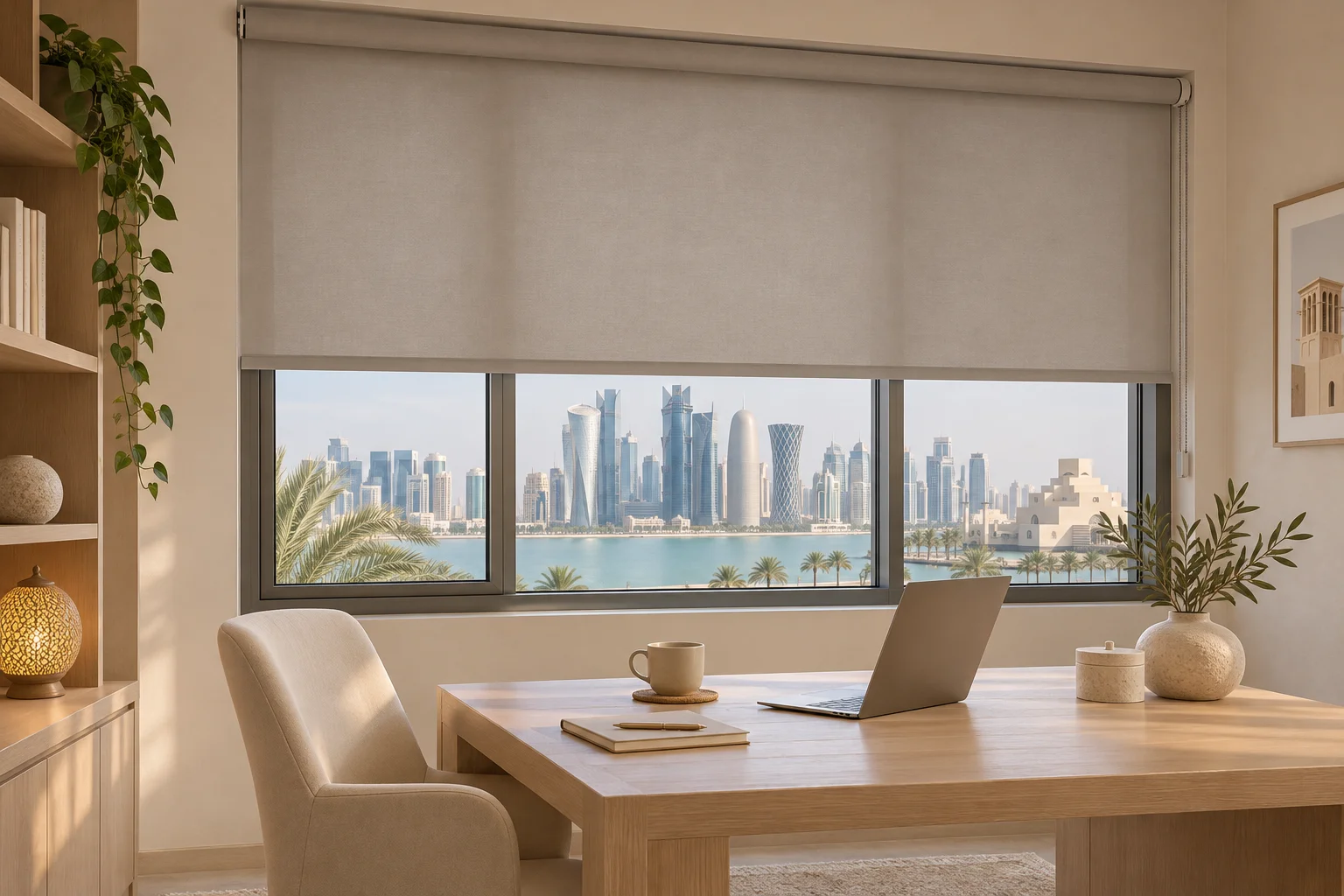
Illustrative inspiration · materials confirmed from samples
01
Look at the complete width
The bracket-to-bracket width is not necessarily the fabric width. Ask how much material covers the glass and what clearance remains at the sides. Recess depth, handles and the direction of the roll can affect the fitting.
02
Compare the actual material
A light-filtering panel softens daylight, while an opaque material reduces light through the fabric. A more open screen may retain a view under some conditions. Compare samples; those labels alone do not establish night privacy or installed darkness.
03
Plan around the opening
A tall balcony door or an opening window needs enough clearance for the blind and controls. Split blinds may be more practical than one large panel in some layouts. Check the mechanism limits rather than assuming every width can be made as one piece.
04
Choose a safe operating arrangement
Agree the control side and the suitable safety devices for any chain operation. Motorized options require a compatible system and confirmed power arrangement. Keep the supplied instructions for use, adjustment and care.
A FEW PRACTICAL DETAILS
Before you choose
Will opaque fabric stop light at the sides?
Light can enter beside the fabric. Coverage and any additional system features need to be discussed.
Can it go in a recess?
Only if depth, fixings and window movement allow a suitable fit.
Keep exploring
YOUR NEXT CHAPTER
Let’s make your room feel finished.
Share a room photo on WhatsApp and tell us the look you love. Final materials and fitting are confirmed together.